CIWM’s new soil workbook points one way: evidence before it moves

CIWM’s Built Environment Specialist Expert Group has released a draft Waste Classification Sampling Workbook, a practical guide to planning, sampling and classifying excavated soil before it leaves site in England and Wales.
What’s been released
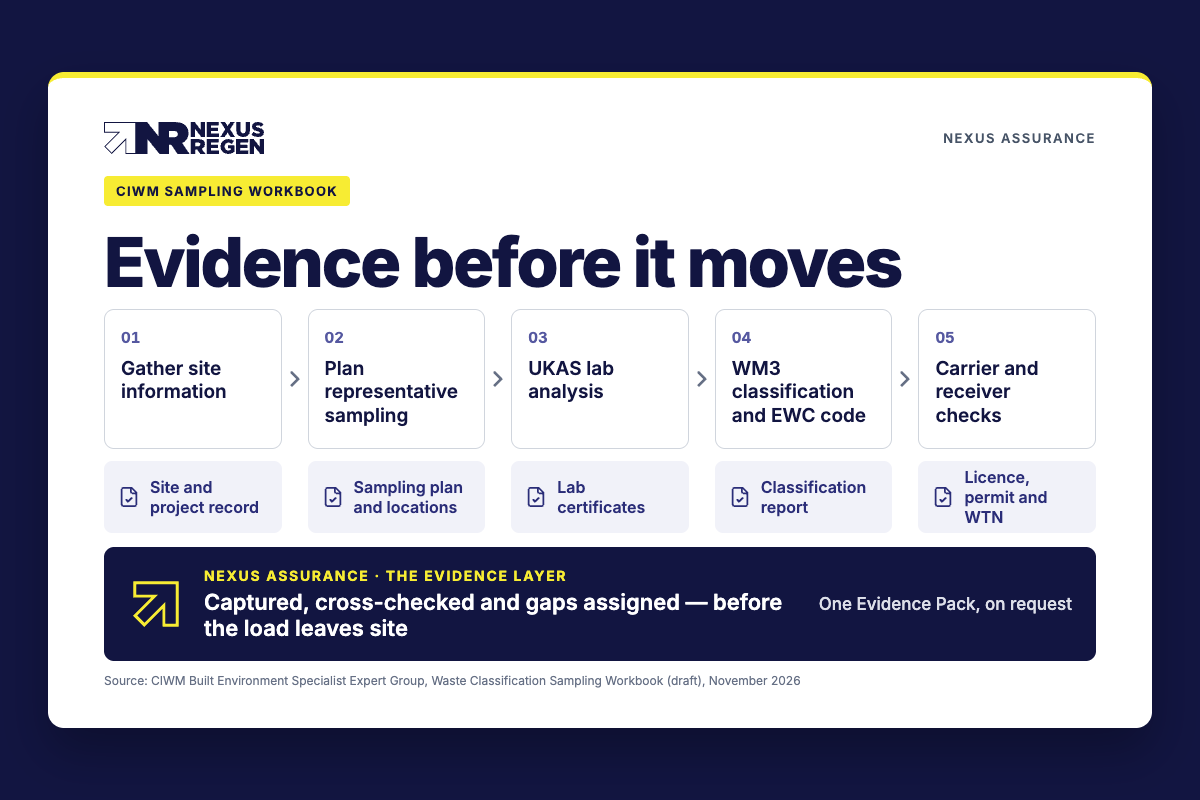
The workbook takes waste producers, contractors, samplers, laboratories, carriers and receiving sites through the full process: gathering site information, planning representative sampling, UKAS-accredited analysis and WM3 classification, through to the correct EWC code. It closes with duty of care checks on the carrier and receiving site, completed before any material moves.
It works as a record as much as a guide. Users document how the classification decision was made and what evidence it relied on, and the resulting Waste Classification Report should be available to third parties on request. It also restates a point the industry still underestimates: the waste producer is jointly liable with the carrier for duty of care.
The workbook is currently marked as a draft for review.
The direction of travel: checks before movement
Alongside Digital Waste Tracking, the message is consistent. Compliance is no longer assembled after the event. In the workbook’s worked example, a receiving facility accepts soil only after reviewing the classification report, EWC code, lab results and transfer documentation before delivery. If stockpiles may have been mixed, movement should stop until competent advice is sought. And carrier competence requirements are expected from 2027.
Each of these moves the critical moment earlier: from audit to before a load leaves site.
Where Nexus Assurance fits
Nexus Assurance is built around that moment. Before a load moves, a Movement Proposal declares what’s moving, where it’s going, who’s carrying it and what evidence supports it.
The documents the workbook asks for, from the classification report and laboratory certificates to carrier registration and the receiving site’s permit, are read automatically on upload. Assurance then checks them against each other and against the proposal. Does the EWC code on the transfer note match the classification report? Is the receiving site permitted for that waste? Is anything missing? Gaps are flagged as they arise and assigned to a named owner, across every tier of the supply chain.
Assurance doesn’t replace the competent people the workbook calls for. Sampling and WM3 classification stay with qualified classifiers and laboratories, and a named person signs off every compliance decision. Assurance makes sure their work is complete, consistent and still matches the load when it moves.
When the Environment Agency, an auditor or a client asks, an Evidence Pack brings the proposal, loads, documents, checks and sign-offs together in one defensible record.
Digital Waste Tracking proves a movement happened. The CIWM workbook sets out how to prove what was in it. Nexus Assurance is the evidence layer that proves it was compliant, checked before it left site.
Source: CIWM Built Environment Specialist Expert Group, Waste Classification Sampling Workbook (draft, November 2026) — https://ciwm.co.uk/media/3qfpjckr/be-seg-workbook-final-021126.pdf