What every housebuilder and contractor should learn from Operation Unite

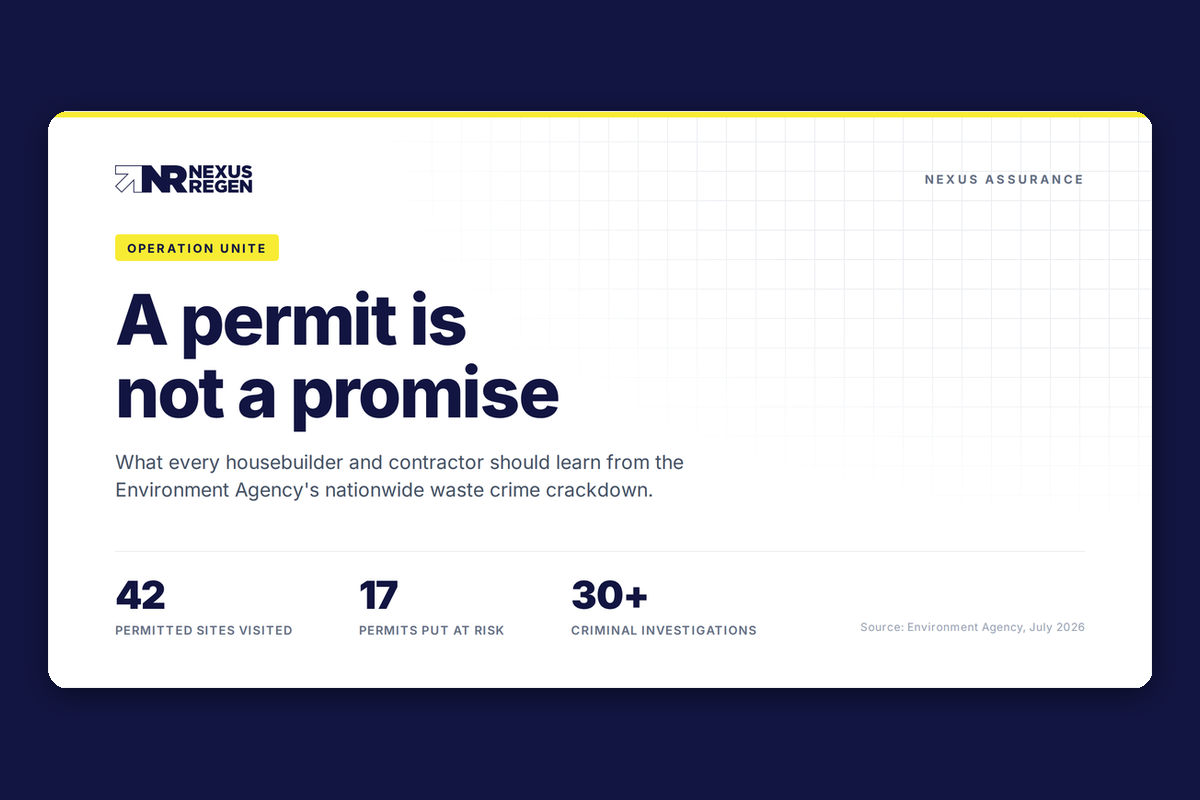
Hint: a permit is not a promise.
Between March and July 2026, Environment Agency officers visited 42 waste sites across England as part of Operation Unite, an 18-week nationwide enforcement operation. Every one of those sites held a permit.
By the time the operation closed on 24 July, it had produced 17 permits suspended, facing revocation, or both, and more than 30 new criminal investigations. It also generated fresh intelligence that the EA has said will keep pressure on operators for months to come.
These were not random inspections. The EA targeted permitted sites where intelligence suggested a risk of criminal activity, so the strike rate reflects good targeting rather than the state of the whole sector.
This is how they operate now: the regulator has an intelligence picture, and is acting on it. Operation Unite was described by the EA's chief executive as the beginning, with further targeted operations already planned.
The findings
On the outskirts of Chichester, a multi-agency visit to a waste tyre processor identified multiple fire safety issues and a heightened pollution risk. The permit was suspended immediately and the operator had to stop accepting waste and clear the site.
In Hull, a facility permitted to handle more than 750,000 tonnes of hazardous and non-hazardous waste a year was found to have a significant fire risk and other breaches of permit conditions. When a follow-up operation found the issues unresolved, a suspension notice was served.
In Watford, a construction company holding a waste permit was found to have multiple breaches alongside a repeated failure to comply. Its permit was suspended while it came back into compliance.
In West Lancashire, two sites were shut down and a permit revoked. The trigger there was not an inspection schedule; it was residents complaining about foul smells and dust.
What does this mean for waste producers?
None of the above is a story about waste producers. It is a story about waste sites.
BUT if you are a developer or a contractor, these places are where your material goes once it leaves your site. Your Duty of Care does not stop once the material has left your site. You are required to take reasonable steps to ensure your waste is handled correctly by whoever you pass it to, and to keep the paperwork that proves it.
So the question is simple, and most organisations cannot answer it quickly. If one of the sites you use had its permit suspended this week, would you know? Would you know how much of your waste went there last quarter, from which projects, and on whose ticket?
Two things happen when a receiving site goes down: your waste stops moving, and you start explaining.
What's next?
Operation Unite forms a central part of the EA's 10 Point Plan to tackle waste crime, launched in March 2026. Around it sits a widening enforcement apparatus.
A national watchlist of 117 high-priority waste sites was published in May, and is reviewed monthly. Annual heat maps published on 2 September show where suspected waste crime is being reported, drawn from 10,238 public reports received in 2025. The government has committed £45 million to EA enforcement through its Waste Crime Action Plan, and a new Waste Crime Crackdown Group, chaired by the Environment Secretary, brings regulators and law enforcement together. Greater use of drones, a bigger role for mayors and police forces, and higher fines are all part of the same push.
The direction is one way, and it is intelligence-led. The EA's own framing is that acting earlier and responding to community intelligence is now the default.
October: Digital Waste Tracking
From October 2026, digital waste tracking becomes mandatory for receiving sites in England. Every movement of waste will carry a digital record.
For the many organisations still running on paper transfer notes, spreadsheets, and subcontractor assurances, that changes the nature of the problem. Compliance stops being something you assemble after the fact, when someone asks. It becomes a live record that either exists or does not. The organisations that will find October straightforward are the ones who already know where their waste goes, in real time, without having to go and find out.
And how does Nexus ReGen fit into this?
Waste crime is a supply chain problem, and construction is one of the largest producers in that supply chain. Enforcement is currently pointed at operators. It is not difficult to see the attention travelling upstream, particularly once digital tracking makes the chain visible end to end.
This is the gap Nexus Assurance was built to close. It gives waste producers a live, evidenced view of where their material goes and who handles it, so Duty of Care is something you can demonstrate rather than something you hope holds up. We sit alongside your Digital Waste Tracking tool, and integrate with it and how you collect your data, so we do not force any changes for the people on the ground.
Digital Waste Tracking adds the visibility of waste movements, but Nexus Assurance adds the evidence layer, and you need both.